



A crane OCR system reads container numbers and other codes automatically as containers are lifted, so terminals no longer depend on clerks noting them by hand. It speeds up loading and unloading, cuts errors and keeps the terminal operating system (TOS) up to date in real time. This guide explains what a crane OCR system is, how it works, its key features and benefits, and where it is used.
Key takeaways
- Crane OCR uses cameras and optical character recognition mounted on quay, RTG, RMG and stacking cranes.
- It captures container numbers, ISO codes, seal presence, door direction and truck details in real time.
- Data is sent straight to the terminal operating system, removing manual entry.
- Benefits include faster turnaround, better safety, higher accuracy and full traceability.
What is a crane OCR system?
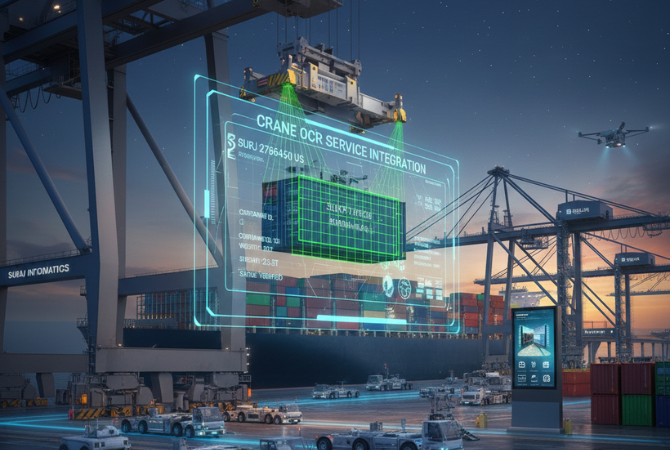
Optical character recognition (OCR) for cranes automates the identification, tracking and verification of containers during loading and unloading. A crane OCR system is installed on quay cranes (QC), rubber-tyred gantry cranes (RTG), rail-mounted gantry cranes (RMG) and automated stacking cranes (ASC).
High-resolution cameras and OCR software capture container numbers, ISO codes, seal presence, door orientation and the licence plates of trucks in real time. The data is processed straight away and sent to the terminal operating system (TOS), so every system in the terminal stays in step.
How a crane OCR system works
- Capture. Cameras on the crane photograph the container from several angles as it is lifted.
- Recognise. OCR software reads the container number, ISO code and other markings, and checks seals and door direction.
- Verify. The result is checked against the expected container and job; exceptions are flagged for review.
- Update. The confirmed data is sent to the TOS or ERP, together with images for the record.
Key features of a crane OCR system

- High-resolution imaging: crane-mounted cameras capture clear images from multiple angles.
- Real-time processing: container IDs are read and placement is checked within moments, and damage can be flagged.
- TOS and ERP integration: data flows into the terminal operating system or ERP without re-keying.
- Weather-resistant design: industrial-grade components for 24/7 operation in rain, heat and dust.
- AI-assisted accuracy: machine learning helps recognition improve over time.
- Analytics and reporting: dashboards show crane productivity in real time and over time.
Benefits of crane OCR for ports and terminals
| Benefit | What it means for the terminal |
|---|---|
| Reduced dwell time | Real-time capture speeds up container moves and turnaround |
| Better safety | No need for staff to check numbers in dangerous crane areas |
| Higher accuracy | Manual data-entry errors are removed |
| Faster documentation | Electronic records and customs data are ready sooner |
| Traceability | Every container move is recorded with images for audits and disputes |
| Lower costs | Less manual labour and better use of cranes and equipment |
Where crane OCR is used

- Quay cranes: read container numbers during ship-to-shore and shore-to-ship moves.
- RTG and RMG cranes: track containers within yard blocks to prevent misplacement and keep stacks accurate.
- Transfer points: monitor trucks and containers at interchange points for better planning.
Crane OCR is one part of wider container terminal automation, alongside gate, rail and yard systems.
Crane OCR from Suraj Informatics
Suraj Informatics provides crane OCR service and integration for ports and container terminals. Each system is configured to the terminal’s cranes, infrastructure and workflow, with onboarding, maintenance and support to keep it running. It can work alongside gate, rail and yard automation on the GATIVRA platform.
Crane OCR system: common questions
What is crane OCR?
Crane OCR is a camera and software system on port cranes that automatically reads container numbers, ISO codes and other markings as containers are lifted.
Which cranes can use OCR?
Quay cranes, rubber-tyred gantry (RTG) cranes, rail-mounted gantry (RMG) cranes and automated stacking cranes can all be fitted with OCR.
Does crane OCR connect to the TOS?
Yes. Recognised data and images are sent to the terminal operating system so container records update without manual entry.
Can crane OCR work at night and in bad weather?
Yes. Systems use industrial-grade cameras and lighting designed for round-the-clock operation in outdoor port conditions.
Talk to our port automation team
Tell us about your cranes, terminal layout and TOS, and we will suggest the right crane OCR setup.