

Transforming Logistics: The Strategic Impact of an Automated Warehouse Management System

Transforming Logistics: The Strategic Impact of an Automated Warehouse Management System
A look at how modern warehouse management systems, inventory management platforms, and automated dock scheduling are helping warehouses shift from storage space to a central engine of enterprise commerce.
In today's hyper-connected, fast-moving supply chain landscape, the warehouse is no longer just a passive storage space — it is the central engine of enterprise commerce. As order volumes surge and delivery timelines compress, traditional manual handling methods become major operational liabilities. Relying on paper checklists, uncoordinated yard handoffs, and disconnected stock sheets leads directly to stock discrepancies, labor bottlenecks, and costly shipment delays.
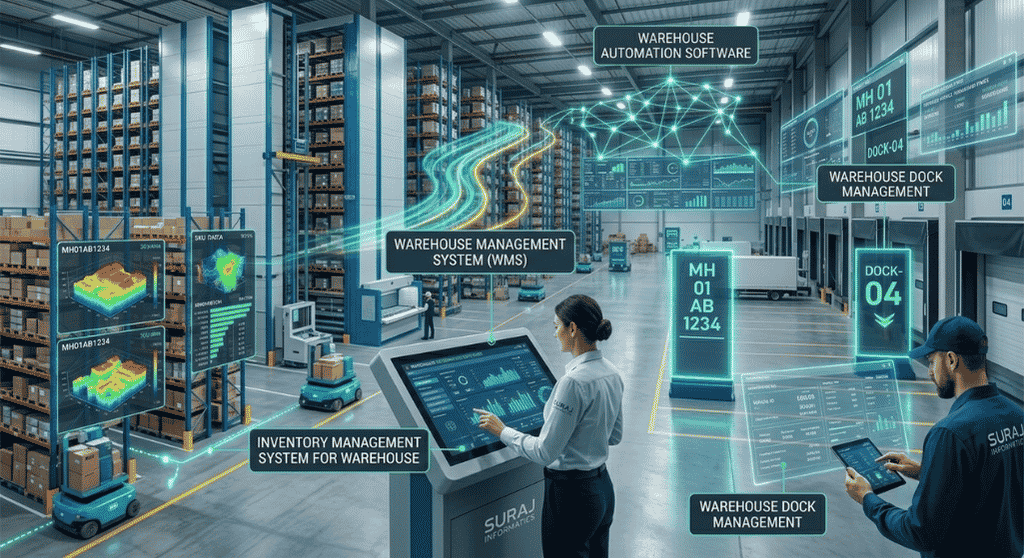
To build resilience and scale fulfillment capabilities, enterprises are modernizing their facilities with advanced digital infrastructure. Implementing a robust warehouse management system (WMS) enables organizations to gain complete end-to-end operational visibility, optimize floor workflows, and ensure maximum order precision around the clock.
Intelligent Inventory Control: The Inventory Management System for Warehouse
At the core of an efficient facility is a high-precision inventory management system for warehouse environments. Rather than periodic manual audits, automated inventory architectures leverage IoT sensors, high-speed barcode scanning, and RFID tracking to monitor stock dynamically.
In these systems, every SKU movement — from receiving and quality inspection to racking, picking, packing, and dispatch — is validated and logged in real time. Many platforms also suggest optimal slotting configurations based on product turnover velocity and seasonal demand, so that high-frequency goods stay easily accessible.
Orchestrating the Gate and Bay: Warehouse Dock Management
Operational efficiency inside the warehouse is only half the battle; logistics velocity depends equally on seamless loading bay throughput. A dedicated warehouse dock management module connects yard logistics directly to internal warehouse operations. Automated dock scheduling is intended to eliminate the chaos of unannounced truck arrivals, letting logistics planners assign dedicated time slots and specific dock doors based on cargo type, equipment availability, and labor capacity.
-
01
Reduced Turnaround Time (TAT)Pre-allocated dock assignments and automated gate validation are designed to speed up loading and unloading cycles.
-
02
Elimination of CongestionCoordinated truck staging aims to prevent vehicle pileups at facility gates and yards.
-
03
Seamless Labor CoordinationWarehouse floor teams can receive advance notice of inbound cargo, allowing them to stage equipment and personnel before the truck docks.
Strategic Advantages of End-to-End Warehouse Automation
Industry analysts point to several long-term returns from investing in comprehensive warehouse management system solutions:
Maximize Labor and Space Utilization
Automation is meant to remove guesswork: systems can generate intelligent picking paths (batch, zone, or wave picking) to reduce operator fatigue and lift daily throughput. 3D volumetric slotting can also help maximize vertical cubic space without costly facility expansions.
Seamless Enterprise ERP Synchronization
Modern automated platforms typically integrate via direct API with central ERP systems like SAP, Oracle, and Microsoft Dynamics, so sales, procurement, and logistics teams can work from unified, up-to-the-minute stock data.
Data-Driven Decision Making
Centralized analytics dashboards aggregate operational KPIs — including dock turnaround times, order fulfillment rates, and worker productivity — which operations executives can use to identify friction points and refine standard operating procedures.
Suraj Informatics' Approach to Enterprise Automation
Among the vendors operating in this space is Suraj Informatics, which positions itself as a provider of end-to-end industrial automation solutions for logistics hubs, manufacturing plants, and distribution centers. According to the company, deploying a scalable, high-throughput warehouse ecosystem requires ruggedized hardware integration alongside the software layer.
Suraj Informatics says its platform combines automated control, RFID-enabled tracking, and automated dock management, with the stated goal of turning warehouse operations into a more cost-effective, higher-performance function for the enterprises that adopt it.
Conclusion: Build the Warehouse of Tomorrow
In a modern supply chain, operational friction is a risk businesses can ill afford. Moving to an intelligent warehouse management system is one route operators are using to help protect margins, reduce dock delays, and improve fulfillment reliability from gate to dock.
Considering a warehouse automation upgrade?
Suraj Informatics offers consultations for businesses evaluating automated warehouse management systems.