
The Glass Pipeline: Redefining Logistics with Real-Time Container Tracking Systems

The Glass Pipeline: Redefining Logistics with Real-Time Container Tracking Systems
In the complex framework of global trade, maritime shipping, and multi-modal logistics, containers are the lifeblood of commerce. However, traditional tracking frameworks have historically relied on fragmented data—such as manual spreadsheets, delayed EDI messages, and gate check sheets. This lack of continuous visibility creates massive blind spots. When operations managers cannot instantly determine a container status, it leads directly to yard congestion, expensive demurrage fees, and lost productivity.
To achieve competitive speed and complete transparency, industrial logistics teams are abandoning passive tracking practices. By introducing intelligent, automated container tracking platforms, enterprises can monitor cargo movement continuously across land, sea, and rail.
Moving Beyond Milestones: The Shift to Dynamic Supply Chain Traceability
Historically, tracking a container meant waiting for a milestone notification: an update showing it left a port or passed through a terminal gate. While functional on paper, milestone tracking leaves massive information gaps. If a cargo container is delayed at an inland checkpoint, re-routed due to port congestion, or subjected to cargo tampering, supply chain managers often find out days after the event occurs.
Modern asset visibility relies on a proactive, data-driven approach. Advanced automation enables logistics teams to trace container movements continuously. Instead of wondering where an asset is stuck, operators monitor exact physical positions, speed, and environmental conditions in real time, transforming a historically unpredictable process into a predictable, transparent workflow.
The Tech Stack Behind an Advanced Container Tracking Platform
A professional tracking framework operates as an interconnected IoT and AI ecosystem. Rather than relying on a single data source, it aggregates inputs from multiple hardware layers to create a single source of truth:
-
IoT & Long-Range Telemetry: By combining GPS, GSM, and satellite connectivity, tracking nodes attached to high-value containers transmit exact coordinates regardless of how remote the location is.
-
High-Speed OCR Systems: Specialized Optical Character Recognition (OCR) cameras mounted on port cranes and rail infrastructure read container numbers and ISO codes in motion. This ensures $99\%+$ data accuracy during loading and unloading without interrupting operations.
-
RFID & Short-Range Sensors: RFID and Bluetooth Low Energy (BLE) tags provide granular interior tracking, keeping a precise $1:1$ inventory record of pallets and high-value cargo within yards and warehouses.
-
Environmental Condition Probes: For sensitive cold chain cargo, integrated sensors continuously evaluate ambient factors like temperature, humidity, shock, and light exposure.
Strategic Advantages of Automated Container Management Solutions
Implementing comprehensive container tracking solutions delivers significant financial and operational advantages across ports, dry docks, and intermodal terminals:
1. Optimized Yard Utilization and Shuffling Reduction
Without precise structural tracking, containers can easily become lost in vast logistics yards. Automated visibility creates a “digital twin” of terminal operations. Knowing the exact coordinate of every unit allows managers to optimize crane movements, eliminate unnecessary container shuffling, and directly lower vessel turnaround times.
2. Proactive Geofencing and Security
Asset security is a top priority during transit. Advanced software enables managers to establish precise geofenced corridors. If a vehicle carries a container outside its pre-mapped route or enters an unauthorized territory, the system triggers an instant alert to the central command room, allowing for immediate intervention against cargo theft or diversion.
3. Automated Digital Chain of Custody
Manual paperwork hand-offs are a prime source of operational friction and invoicing delays. Every gate cross, weighbridge scan, and crane hoist is recorded digitally with precise location and time stamps. This generates an unalterable audit trail that streamlines regulatory compliance, accelerates invoicing, and quickly settles vendor disputes regarding delays.
Why Partner with Suraj Informatics for Logistics Automation?
Deploying a global tracking architecture requires industrial-grade reliability and seamless enterprise integration. At Suraj Informatics, we develop end-to-end port, yard, and supply chain automation frameworks tailored for high-volume environments.
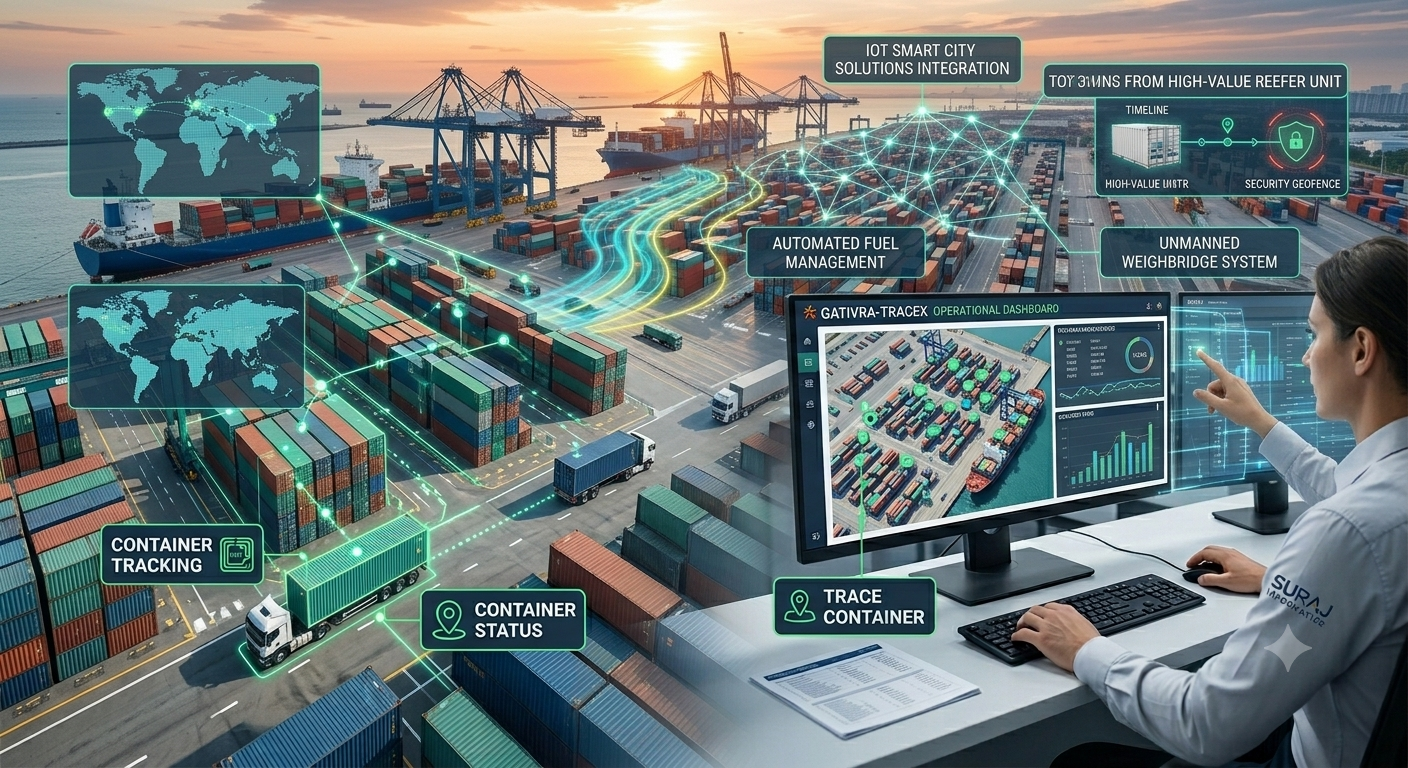
Our signature visibility platform, Gativra-TraceX, connects hardware intelligence with your core enterprise layers. Featuring direct API integration into major Terminal Operating Systems (TOS) and central ERP frameworks like SAP or Oracle, our solutions empower your business to run faster, eliminate manual bottlenecks, and maintain complete operational control.
Conclusion: The Power of Absolute Cargo Visibility
In modern logistics, ignoring cargo blind spots is a massive financial risk. Upgrading to an automated system to monitor container status protects your high-value cargo, lowers operational expenses, and ensures your supply chain operates at peak efficiency.
Ready to bring complete transparency to your operations? Contact the automation experts at Suraj Informatics today at sales@surajinformatics.com to discover our Gativra-TraceX solutions.